https://hothardware.com/news/banana-pi-server 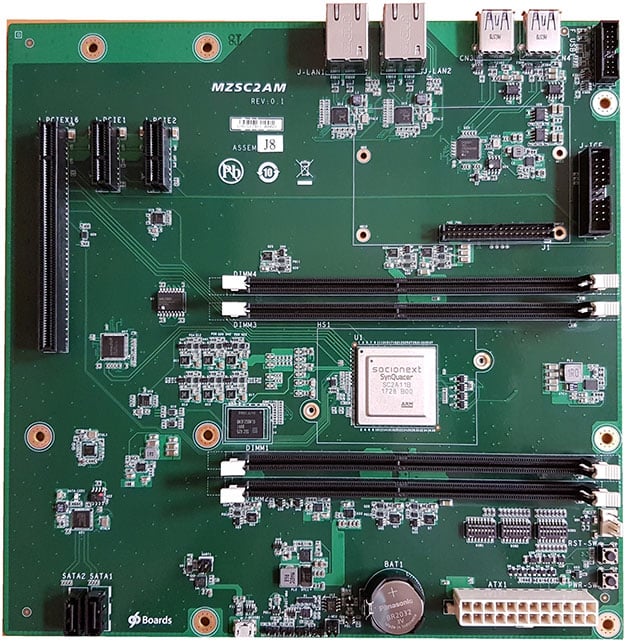
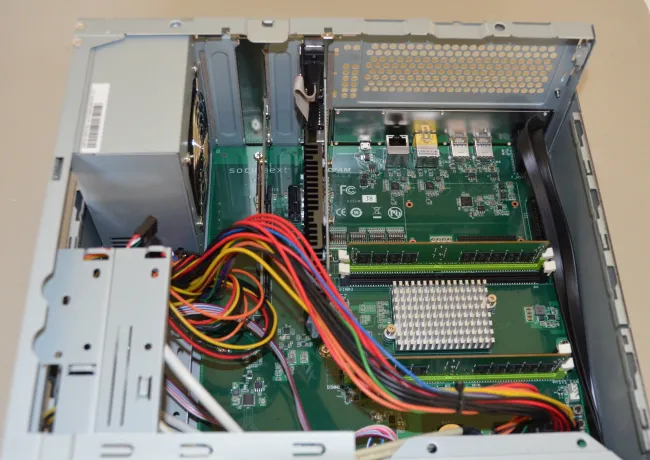
The video immediately below shows the 24 each Cortex A-35 cores of the Socionext server board being fully utilized while building the Linux kernel. This task simply shows all 24 cores can be loaded to the max using Ubuntu 18.4 LTS software while doing a major Linux kernel build, not that you would ever have to do that particular task. A simple finned heat sink with no fan is all they are using with it right now, and the heat sink fins are only like 3/8" tall with NO COOLING FAN NEEDED. The cores (lithography unknown) are clocked at 1 ghz per core, steady state. If utilized, they ramp up to 1 ghz and stay there for moderate cooling load purposes as you already get 2x the throughput of an Intel system and there is no reason seen to clock it higher and require a bunch of fans or other esoteric cooling.
Liquid water and fan cooling could easily run it on up to 2-3 ghz, for example, but nobody sees a need for that right now and the BIOS currently does not support those speeds anyway right now either.
The Cortex A-35 super efficiency core is being used for a reason, not for speed but for the absolute lowest current draw and absolute best battery life. Right now the full out 1ghz current draw for all 24 cores is a whopping 5 watts of power consumption. Running it faster eats more energy and makes excess heat --- i.e. by definition "more inefficient".
https://youtu.be/EbYI9f-KeDk it is a video, click on it
Watching the files roll down the screen also gives you an idea of the fairly decent response time you can get out of the Socionext 24 core ARM server doing a Linux kernel recompile job. In short, for some normal single thread single core small tasks, it might not be so world beating great when compared to power hungry Intel machines ----- but for larger tasks that can actually use the many many cores on a larger steady running job it isn't shabby at all. Using appropriate style tasks for a server, the Socionext offers 2x the performance of Intel at 60% of the energy cost ----- a big big advantage in small server space to say the least.
Other tidbits about the board come from LinkedIn comments from someone named Nora, who is said to be Project Manager for Banana Pi at Foxconn. The comments claim the board supports NVMe storage and that TensorFlow (for machine learning) under Docker, Raspbian, and ROS Melodic Morenia have all been tested on the board. There is no finalized indication of pricing or availability at this time.
$1200 per unit is the current talking price for a fully set up server (this is dirt cheap for a complete server of any sort).
The bearded guy is real however and he comes from LENARO who is working on putting the many core arm world together with software, drivers and pre-approved hardware all tucked inside the Linux Kernel to make sure it is all instantly recognized and it all is working together properly. YES, THESE ARE LENARO REFERENCE DESIGNS, AVAILABLE TO ANYBODY.
Power cost is said to be 60% of what an equivalent Intel server processor would use while turning out twice the processing throughput power of the Intel server (both doing the same workload).
One assumes a particular small Intel server is being benchmarked, but which one is not stated just yet.The CES show is coming together now and these early guys are already set up and demoing to the FOSS people right now, a full week before the show starts .....
Intel is getting hurt again very very early on in the CES set up week by fast moving people slicing whole little wee chunks off their Intel market share pie using ARM technology.
https://youtu.be/kIwop47HDtw it is a video, click on it
https://youtu.be/4gSkTuWR2nc====================================================
Year 2019 market loss by Intel is estimated wind up at a significant fraction of the generic yearly equipment replacement rate of 25%.
To go higher than this would be a very significant occurrence indeed.
Theory is that a large number of machines go obsolete and get replaced with something. To get replaced before then requires a POSITIVE PAYBACK analysis for most businesses.
The little servers offer a 2 year payback on energy savings, going down to a one year payback after counting in on the much lower purchase price point, so they might move in a little faster.
Fastest of all will be the hobby / enthusiast's machines which can be replaced upon some sort of perceived benefit, whether real or financial or not.
So far the little ARM Cortex A-35 Socionext 24 core processor is in 5 different products that are on sale at Computex 2019. The prices vary wildly as do the boards themselves, as they are constructed differently for different applications. They all use the same chipset though, a brand new one which will come down in price tremendously if the volumes go up due to it being successful.


 Pages: